Money, tipping, and prices in Cape Town
What a coffee, a taxi and a steak actually cost, plus the six tipping situations that trip up visitors — from the 10 percent restaurant standard to the R5 car guard.
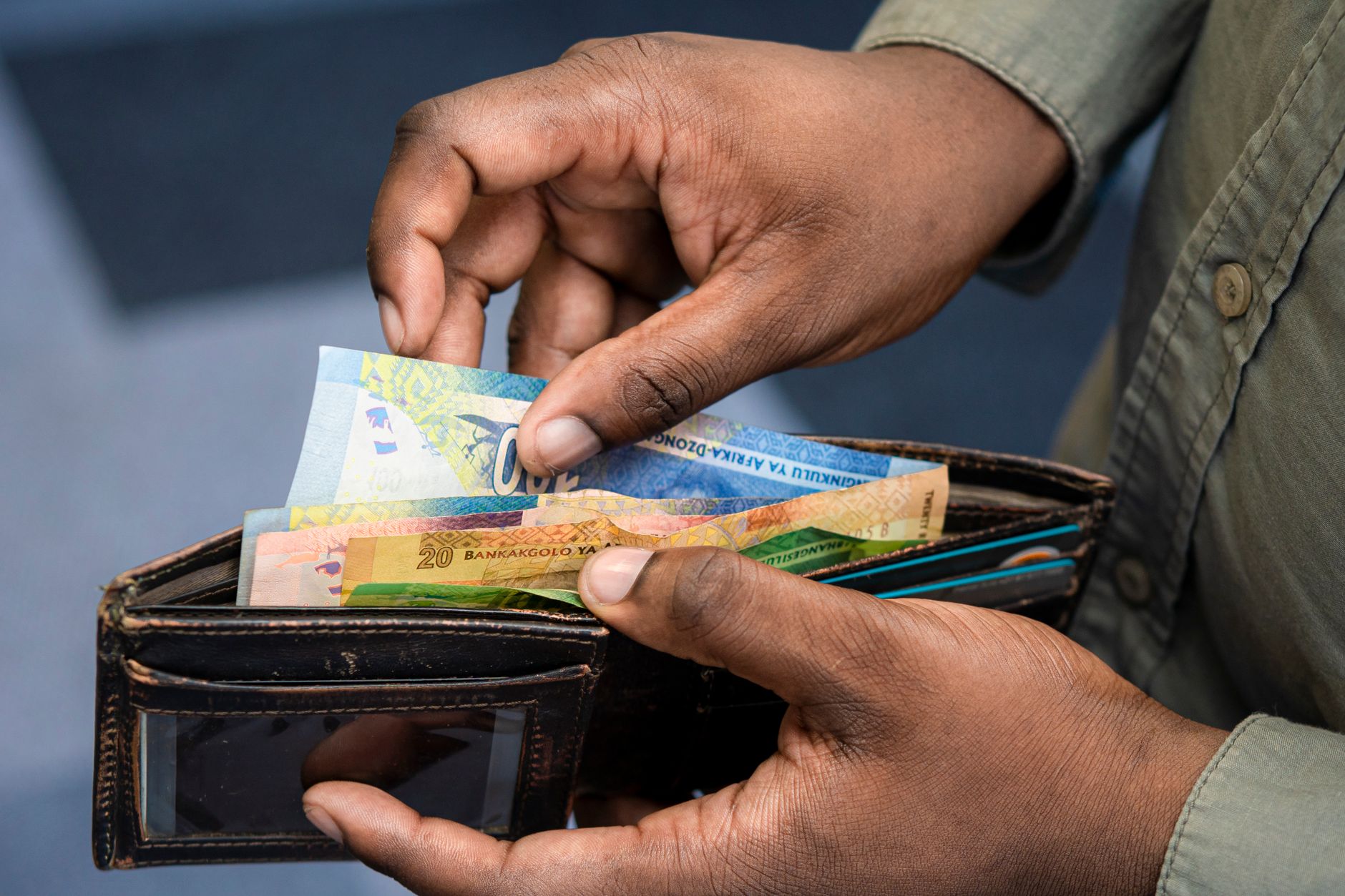 South African rand notes and coins beside a restaurant bill
The rand and what things actually cost
South Africa uses the rand, written R, divided into 100 cents. Notes come in R10, R20, R50, R100 and R200; coins run from 10c to R5. The currency moves a lot against major currencies, which is why Cape Town swings between feeling cheap and feeling ordinary depending on the year you visit. Prices in restaurants and shops always include 15 percent VAT, so the number on the menu is the number you pay before any tip. Nobody haggles in shops or restaurants; the only places you negotiate are craft markets and flea markets.
A useful set of benchmarks: a flat white in a Bree Street or Woodstock café is R35 to R45, a 500ml craft beer R45 to R65, a glass of decent Cape wine R55 to R90, and a bottle of the same wine at the estate R120 to R250. A sit-down main at a mid-range restaurant runs R140 to R220; a good steak at a serious grill R280 to R400. Bottled water is R18, a loaf of bread R20, and a full supermarket shop for two people for three days is around R700 at Checkers or Woolworths.
Cash, cards and ATMs
Cape Town is close to fully cashless in the tourist economy. Cards work at restaurants, cafés, supermarkets, petrol stations, most market stalls with portable card machines, Uber, and even many informal traders. Contactless is widespread and card machines are brought to your table rather than taken away, which is a sensible security norm. Still, carry R300 to R500 in small notes for car guards, petrol attendants, tips, minibus taxis, parking marshals and the occasional cash-only institution like Kalky's in Kalk Bay.
Withdraw at ATMs inside bank branches, shopping centres or the Waterfront rather than on the street, and never accept help from anyone hovering nearby — the classic scam involves a stranger offering assistance and swapping your card. Foreign withdrawal fees typically run R60 to R80 per transaction plus your home bank's charge, so take out R2,000 at a time rather than R500 four times. Always decline dynamic currency conversion and choose to be charged in rand. Bureaux de change at the airport and Waterfront give worse rates than an ATM in almost every case.
Tipping: the actual numbers
Restaurant tipping is not optional in practice: 10 percent is the floor and 15 percent signals you were happy. Waiting staff earn low base wages and depend on tips. Check the bill first — some restaurants add a service charge for tables of six or more, in which case you need not double up. Card machines usually prompt you to enter a tip amount before the transaction. In bars, R10 to R20 per round or 10 percent on a tab is normal. At a café with counter service, rounding up or dropping coins in the jar is fine.
Elsewhere: hotel porters R20 to R30 per bag, housekeeping R30 to R50 a day left in the room, tour guides R100 to R200 per person per day for a group tour and more for a private one, and drivers R50 to R100 for a full-day transfer. Uber tipping is done in the app and R20 on a R100 fare is generous. Hairdressers and spa therapists get 10 percent. Petrol attendants who fill your tank and clean the windscreen get R5 to R10. None of these are enforced, but all are expected.
Car guards, parking marshals and the informal economy
Every public parking space in Cape Town comes with a car guard: someone in a reflective vest who directs you into the bay and watches the car while you are away. They are unemployed or informally employed, not municipal staff, and they earn only what drivers hand over. R5 is standard, R10 for a long stay or if they genuinely helped you reverse out into traffic. Pay on return, not arrival. Keep a pocketful of R5 coins for this specific purpose; it removes an awkward interaction ten times a day.
Official parking marshals in the CBD, wearing branded bibs, are different — they run the metered bays along Long, Loop, Bree and the Waterfront approaches and charge roughly R10 to R14 an hour, issued as a ticket or logged on a handheld machine. That is a real fee, not a tip. Beyond that, the informal economy runs on small coins: trolley pushers at supermarkets, buskers on the promenade, people who help with luggage. R5 to R20 covers almost everything and refusing politely is acceptable.
VAT refunds, levies and the charges people miss
Foreign visitors can reclaim the 15 percent VAT on goods taken out of the country, provided each tax invoice shows the seller's VAT number, your name, and a total above R250. Keep the physical invoices and the goods accessible, and allow an extra 45 minutes at Cape Town International to have items inspected at the VAT Refund Administrator counter before check-in for large items, or after security for hand luggage. The refund is paid to a card or as an electronic transfer, minus an administration fee. Services, accommodation and restaurant meals are not refundable.
On the charges side, most hotels add a 1 percent tourism levy to the bill. Chapman's Peak Drive costs about R60 per car each way. Table Mountain National Park charges conservation fees at Cape Point and Boulders Beach, around R400 for international adults at Cape Point and R200 at Boulders, with much lower rates for South Africans and SADC residents. The Table Mountain cableway return ticket runs roughly R400 to R440 depending on season and time. Wine tastings cost R80 to R250, often waived if you buy bottles.
Sample daily budgets
Backpacker level: R900 a day. That is a R350 dorm bed, a R45 coffee and pastry breakfast, a R90 lunch from Eastern Food Bazaar or a market stall, a R160 dinner with a beer, and R250 of transport and a free activity such as Lion's Head or the Sea Point promenade. Self-catering from a Checkers or Pick n Pay knocks another R150 off. Cape Town rewards budget travellers because so much of what makes it extraordinary — mountains, beaches, promenades, viewpoints — costs nothing at all.
Mid-range: R2,600 a day per person. A R1,400 guesthouse room split two ways plus R1,900 in food, drink, Ubers and one paid attraction such as the cableway or Robben Island. Comfortable: R5,000 and up, covering a four-star room, tasting menus at R900 to R1,600 a head, private guides and wine estates in Constantia. In every band, the single biggest saver is eating lunch as your main meal — many kitchens on Bree, Kloof and Regent Roads run set lunch menus at R120 to R180 that cost double at dinner.
Frequently asked questions
What people ask before they set off on this one.
Ten percent is the minimum and 15 percent for good service. Check whether a service charge has already been added, which some restaurants do for tables of six or more. The card machine will prompt you to add the tip before the transaction, or you can leave cash on the table. Waiting staff rely on tips as a large share of income, so not tipping is read as a complaint rather than a neutral act.
Card for almost everything — restaurants, shops, fuel, Uber, most market stalls. Carry R300 to R500 in small notes and R5 coins for car guards, petrol attendants, parking marshals, tips and the handful of cash-only spots such as Kalky's in Kalk Bay and some minibus taxis. Always choose to be charged in rand rather than your home currency when the machine offers a conversion, since the built-in rate is poor.
Car guards are informal workers in reflective vests who watch parked cars in exchange for tips. They are not employed by the city and have no authority, but paying them is the local norm and the money matters to them. Give R5 for a short stop and R10 for a couple of hours, on your return rather than on arrival. Metered parking marshals in branded bibs are separate and charge a genuine fee of about R10 to R14 an hour.
Yes, on goods you export, at the 15 percent VAT rate, provided each invoice is over R250 and shows the seller's VAT number and your name. Present the invoices and the goods at the VAT Refund Administrator desk at Cape Town International — before check-in for items going into hold luggage, after security for hand luggage. Allow an extra 45 minutes. Meals, accommodation and services do not qualify.
Compared with Western Europe, North America or Australia, no — restaurant meals, wine, taxis and guided activities are considerably cheaper, and a mid-range dinner with wine for two runs R500 to R700. Accommodation in December and January is the exception and can match European prices. Conservation fees, the cableway and boat trips add up, but the city's best experiences — the promenade, the beaches, the hiking trails, Bo-Kaap, the markets — cost nothing or almost nothing.
Hotels in Cape Town
Hotels we cover across Cape Town
- Designer 3 Peaks Apt Stunning Table Mountain Views 2★
- Discover Seaside Charm at Blue Ocean Suite 2★
- Eden on the Bay Apartment 67B 2★
- Electric Jackal 2★
- Elegant Charm Retreat Central Treasure 2★
- Elegant Family Home Eco Pools Sauna Views 2★
- Elegant Fresnaye Ocean View 4bed Nerine Manor 2★
- Elegant Three Bedroom Home 2★
- Ethereal 4bed Camps Bay Villa Atlantic Reflection 2★
- Excel accommodation 2★
- Experience Solace And Panoramic Views at Crescent Bay 2★
- Fairmile Urban Oasis 2★
- Family Home With Views Pool Garden 100 Geneva 2★
- FIR Villa 3 Bedroom House Greenpoint 2★
- Flamingo Villa Beach Pool Luxury Solar Back Up 2★
- Flatrock 505 by CTHA 2★
- FlexiStay Hotel 2★
- Funky Pet Friendly 2 bedroom Escape Bo kaap 2★
- Gardens Loft Studio 2★
- Green Point Micro Lock Up and Go 2★
- Green Point Peaceful Retreat Off grid 2★
- Happy Home Imhoffs Gift 2★
- Hippo Pod Hostel Adults Only Cape Town 2★
- Holiday Apartment w Sea Views Pool CBT Suite 2★
More guides to Cape Town
All guides Itineraries · 9 min read
48 hours in Cape Town
Itineraries · 9 min read
48 hours in Cape Town
Two full days, one mountain, one peninsula drive and roughly R2,500 per person in entry fees, food and transport if you plan the order properly.
 Itineraries · 10 min read
One week in Cape Town
Itineraries · 10 min read
One week in Cape Town
Seven days split as four in the city, two in the Winelands and one on the whale coast, with a realistic all-in spend of about R12,000 per person excluding flights.
 Itineraries · 9 min read
Cape Town in 3 days on a budget
Itineraries · 9 min read
Cape Town in 3 days on a budget
Three days of mountain, coast and city for around R1,800 a person in fees, food and transport, by hiking what other people ride and eating where Capetonians actually eat.
Compare rooms from Woodstock to Camps Bay, pay the same price as anywhere else, and remove a tonne of CO2 in the process.