Bo-Kaap
The steep, cobbled Cape Malay quarter on the slopes of Signal Hill, with the oldest mosque in South Africa, the brightest houses in the city and three centuries of history behind the paint.
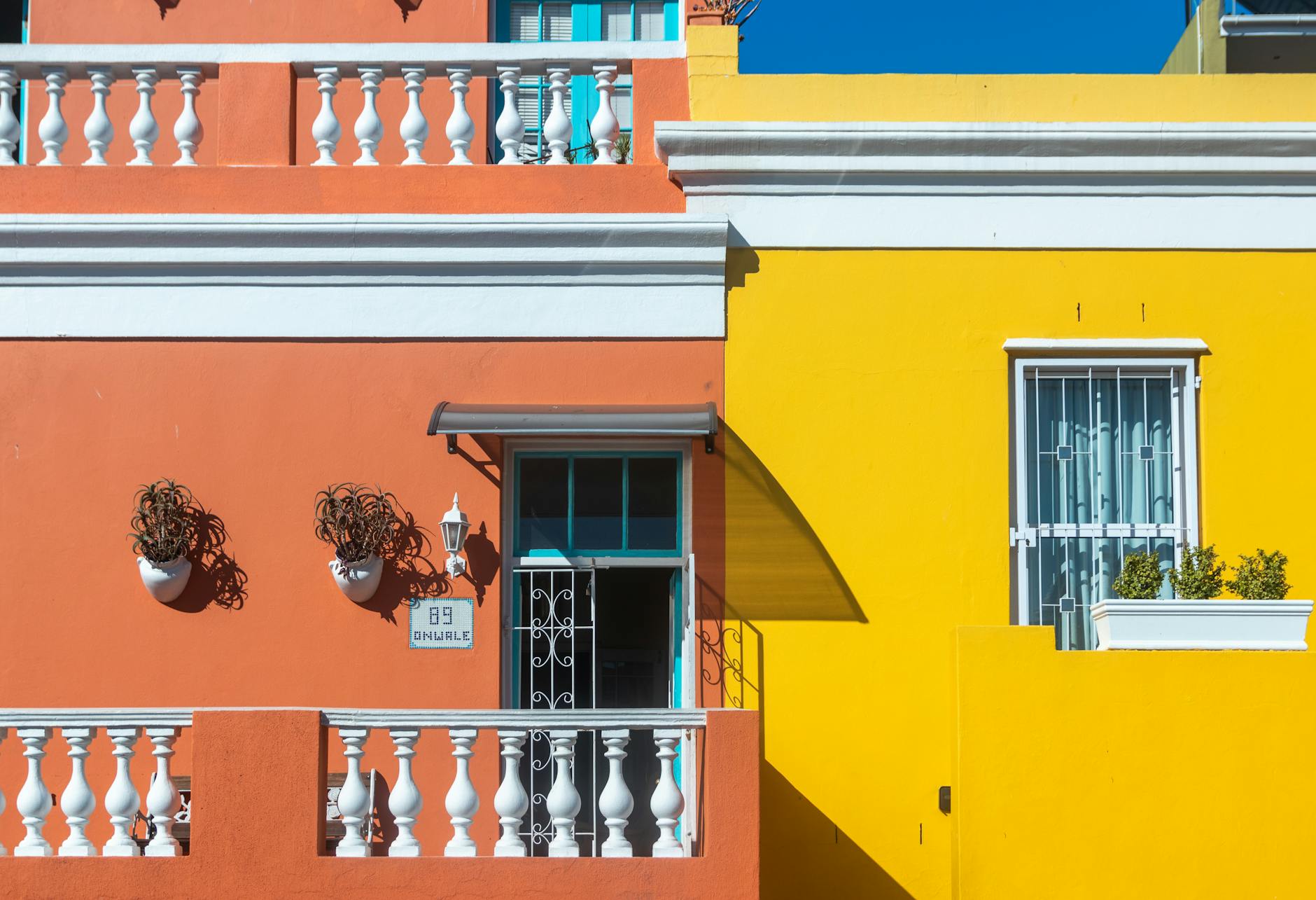 Brightly painted houses on a cobbled Bo-Kaap street with Signal Hill rising behind
What to expect at Bo-Kaap
Bo-Kaap climbs the lower slopes of Signal Hill immediately above the City Bowl, a grid of short, steep, cobbled streets lined with flat-roofed eighteenth and nineteenth-century houses. Its origins lie in the huurhuisjes, rental houses built from the 1760s onward and occupied largely by enslaved and freed people brought to the Cape from Indonesia, Malaysia, India, Sri Lanka and East Africa, along with political exiles from the Dutch colonies. The community that formed here — Cape Muslim, often called Cape Malay — gave Cape Town much of its food, its language and its craft trades. The Auwal Mosque on Dorp Street, established in 1794, is the oldest mosque in the country. The famous colour came much later, mostly in the second half of the twentieth century, and it now covers whole terraces in lime green, pink, cobalt and marigold.
Walking it is the visit. Start on Wale Street where it climbs from Buitengracht, and work uphill through Rose, Chiappini, Leeuwen and Dorp Streets. The gradient is real: these are among the steepest streets in the central city and the cobbles are uneven. The Bo-Kaap Museum sits at 71 Wale Street in one of the oldest surviving houses in the area, furnished to show how a nineteenth-century Muslim family lived, with rooms of household objects, photographs and material on the community's history and displacement under apartheid-era legislation. Along the way you pass corner shops selling spices and koesisters, several mosques with their minarets set among the houses, and, over the rooftops, sudden views straight down onto the city, the harbour and Table Bay.
Plan a morning walk of about two hours. Wear proper shoes for the cobbles and the slope. This is a living residential neighbourhood, not an open-air museum, so photograph the streets rather than the doorways of occupied houses, and ask before pointing a lens at anyone. During Ramadan and on Fridays around midday prayers, keep noise down and stay off mosque steps. A guided walk with a resident guide, usually 90 minutes to two hours, transforms the visit and is the single best money you can spend here; several operators and community guides run them. Cooking classes with local families, where you make roti, samoosas and a Cape Malay curry, are the other worthwhile add-on and take about three hours.
Getting there is a walk from almost anywhere central. From Adderley Street it is 10-12 minutes uphill via Wale Street, crossing Buitengracht at the traffic lights. From Greenmarket Square allow eight minutes and from the Company's Garden around twelve. MyCiTi buses run along Buitengracht and Strand Street with stops five to eight minutes from the lower edge of the quarter and in-city fares of roughly R12-R20. Driving is possible but discouraged: the streets are narrow, steep, cobbled and lined with residents' cars, and parking is genuinely scarce. If you must drive, leave the car in a City Bowl garage on Buitengracht or Church Street at around R15-R25 an hour and walk up. An e-hailed car from the Waterfront is usually R60-R100.
Walking the streets costs nothing. The Bo-Kaap Museum at 71 Wale Street is part of the Iziko group and charges a small entry fee, in the region of R20-R30 for adults with reduced rates for children, students and South African pensioners; Iziko adjusts its tariffs annually, so confirm at the door. Guided walking tours run roughly R350-R650 per person for 90 minutes to two hours. Cape Malay cooking classes typically cost R750-R1,200 per person including the meal. A koesister or samoosa from a corner shop is R10-R30, a plate of curry at one of the local restaurants R120-R200, and a mint tea R25-R40. A complete visit with the museum, a snack and no guide comes in under R100 a head.
Come between 08:00 and 10:00. The light is best on the east-facing painted terraces in the morning, the streets are quiet, and you avoid both the tour groups and the heat, which on the treeless slope between December and February is punishing by midday. Late afternoon light is warm but the crowds are heavier and parked cars clutter the frames. Fridays see the area busy around midday prayers. The Bo-Kaap Museum closes on Sundays and on certain public holidays. Winter, June to August, brings rain and wind up the slope but also the emptiest streets of the year and the most saturated colour under grey cloud. The days after Eid are festive and welcoming but crowded with family visitors.
It suits walkers, photographers, history-minded travellers and anyone who wants a sense of Cape Town beyond the mountain and the beach. It is not an easy visit for wheelchair users or anyone with mobility limits: the gradients are severe, the cobbles rough and the pavements narrow with high kerbs. Small children manage but tire on the hills. Teenagers usually engage more with a guide than without one. It works in an hour if you stick to Wale, Chiappini and Rose Streets. It is a poor wet-weather option, being entirely outdoors, though the museum gives you a dry half hour. Anyone hoping for shopping or nightlife should go elsewhere; this is a quiet residential quarter.
It links naturally into a City Bowl half day. Greenmarket Square and its craft stalls are eight minutes downhill; Long Street with its Victorian balconies is about six; St George's Cathedral and the Company's Garden are ten to twelve minutes. The Noon Gun on Signal Hill, fired at 12:00 every day except Sunday, is a steep 25-30 minute walk up from the top of Bo-Kaap and a genuinely good add-on if you time it. Signal Hill's summit road and the Lion's Head trailhead are a short drive above. Many visitors do Bo-Kaap in the morning, walk down for lunch on Bree Street, and continue to the museums around the Company's Garden in the afternoon.
The honest part. Bo-Kaap is people's homes, and the volume of visitors photographing front doors has worn residents' patience thin in places; a few houses now display signs asking for privacy, and they mean it. The colour, which is what most people come for, is the least historically significant thing about the quarter — turning up only for an Instagram frame and leaving in fifteen minutes misses everything. Gentrification is a live and contested issue here, with rising rates pushing out families who have been in these houses for generations, and it is worth knowing that before you comment on how charming it all is. There are no public toilets. And the steepness is consistently underestimated: from Buitengracht to the top of Chiappini Street is a serious climb in summer heat.
Questions about Bo-Kaap
Walking the streets of Bo-Kaap is free and always has been. The Bo-Kaap Museum at 71 Wale Street charges a small Iziko entry fee of roughly R20-R30 for adults, with lower rates for children, students and South African pensioners; tariffs are revised annually so confirm at the desk. Guided walking tours with resident guides run about R350-R650 per person for 90 minutes to two hours. Cape Malay cooking classes cost around R750-R1,200 including the meal you cook and eat.
The quarter is public street and free to walk at any hour of any day, so there is no restricted window. The museum is the only paid element and it does not run free-entry sessions on a regular schedule, though Iziko sites occasionally waive charges on heritage or commemorative days. If your budget is zero, a self-guided walk up Wale, Rose, Chiappini and Dorp Streets, plus the view over the rooftops, costs nothing and takes an easy 90 minutes.
Two hours suits most visitors: about 75 minutes walking the main streets and the viewpoints, and 30-40 minutes in the Bo-Kaap Museum. A quick photographic loop of Wale, Rose and Chiappini Streets takes under an hour. A guided walk adds context and runs 90 minutes to two hours. If you add a Cape Malay cooking class, block out most of a morning, since classes typically run three hours from shopping or prep through to sitting down to eat.
The streets never close, though visiting after dark is not advised. The Bo-Kaap Museum opens Monday to Saturday, roughly 09:00-17:00, and closes on Sundays and on certain public holidays including Christmas Day and Good Friday. Mosques are working places of worship and are not general tourist attractions; Friday around midday prayers is a time to keep your distance and your voice down. During Ramadan the quarter is quieter by day and lively after sunset.
No booking is needed to walk the streets or to enter the museum, where you simply pay at the door. Guided walking tours and cooking classes should be booked ahead, ideally a day or two in advance and longer in December and January, since group sizes are small and popular slots fill. If you are visiting with a group of more than eight, contact a community guide in advance rather than turning up, as unguided large groups on narrow residential streets cause friction.
MyCiTi bus stops on Buitengracht and Strand Street are five to eight minutes walk from the lower edge of the quarter, with in-city fares around R12-R20. On foot it is 10-12 minutes uphill from Adderley Street via Wale Street, eight minutes from Greenmarket Square and about six from Long Street. Driving is awkward: the cobbled streets are steep and narrow with resident parking, so use a City Bowl garage on Buitengracht or Church Street at roughly R15-R25 an hour and walk up.
Hotels near Bo-Kaap

Every hotel we cover in City Bowl
- The Famous Bokaap Villa 0.1 km away
- Alexa By Stay Amazing 4★ · 0.2 km away
- Beautiful Appartement With Balcony and Great View at Bokaap 2★ · 0.2 km away
- FZP Apartment Rentals 3★ · 0.2 km away
- Shortmarket 136 4★ · 0.2 km away
- Luxury Penthouse with Private Pool 0.2 km away
- Stunning House in Bo Kaap 4★ · 0.2 km away
- Manhattan Penthouse 4★ · 0.3 km away
- Manhattan Place 4★ · 0.3 km away
- Cape Town Heritage Hotel & Spa 4★ · 0.3 km away
- Manhattan Studio 914 4★ · 4.5/5 · 0.3 km away
- Dutch Manor Antique Hotel 4★ · 4.3/5 · 0.3 km away
- 22 On Rose 3★ · 4.4/5 · 0.3 km away
- Table Mountain View Villa 4★ · 0.3 km away
- Wild Artz 3★ · 0.3 km away
- The Carrington 505 4★ · 0.3 km away
- Cape Heritage Hotel 4★ · 4.6/5 · 0.3 km away
- Soho A17 4★ · 4.1/5 · 0.3 km away
- Cosy Studio in the heart of Cape Town 4★ · 0.3 km away
- Always Power De Waterkant Mountain View Apartment 4★ · 0.3 km away
- 8 on Upper Bloem 4★ · 4.6/5 · 0.4 km away
- City View Balcony Apartment 908 4★ · 0.4 km away
- 91 Loop Hostel 2★ · 0.4 km away
- The Dolls House 3★ · 0.4 km away
More things to do
All things to do


From the journal
All posts Hotel round-ups
Hotels with pools in Cape Town
Hotel round-ups
Hotels with pools in Cape Town
The Atlantic sits at 12-16°C most of the year, which is why a heated hotel pool is worth paying R400 a night extra for — here is where to find the good ones, by area and price band.
 Hotel round-ups
Best beachfront hotels in Cape Town
Hotel round-ups
Best beachfront hotels in Cape Town
Cape Town has roughly 70km of coastline inside the metro and startlingly few true beachfront hotels — here is where the sand-to-lobby options actually are, in six areas, with the honest catch on each.
 Hotel round-ups
Hotels with Table Mountain views in Cape Town
Hotel round-ups
Hotels with Table Mountain views in Cape Town
Table Mountain is 1,086m high and looks completely different from six different suburbs — here is which side of the city gives you the flat-topped postcard from your bed, and which gives you a wall of grey rock.