Hotels with Table Mountain views in Cape Town
 Hotel room window framing the flat summit of Table Mountain
Table Mountain is 1,086m high and looks completely different from six different suburbs — here is which side of the city gives you the flat-topped postcard from your bed, and which gives you a wall of grey rock.
The geometry problem: too close and you lose the table
The flat summit only reads as a table from a distance and from the north. Stand in Gardens or Oranjezicht, directly beneath the front face, and your window fills with a 700m cliff — dramatic, but not the shape on the postcards, and in winter it is often just cloud. This is the single most common booking disappointment in Cape Town: guests pay for a mountain-view room in the upper City Bowl and get the equivalent of a seat in the front row of a cinema. It is still a magnificent view. It just is not the photograph they came for.
The classic silhouette — Devil's Peak on the left, the flat table, Lion's Head on the right — needs three to twenty kilometres of separation and a northerly or north-westerly angle. That means the V&A Waterfront and Mouille Point, the De Waterkant and CBD high floors, Woodstock's upper slopes, and above all Bloubergstrand across Table Bay. Everything else gives you a partial. Decide first which version you want, then choose the suburb, then choose the hotel.
Bloubergstrand: the full postcard, R1,200-2,800
Nothing beats Blouberg for the classic view. From the beach at Bloubergstrand, 20-25km north on the R27, the whole massif rises across the bay with Robben Island in the middle distance. Guesthouses and self-catering apartments along the beachfront and up the Sunningdale slope charge R1,200-2,800 for a sea-and-mountain room, roughly half the price of a comparable view elsewhere. Sunsets in summer put the sun behind the mountain around 20:00; in winter it sets further north and the light on the cliffs at 17:00 is the best of the year.
The costs are wind and commuting. Blouberg blows hard from October to March — brilliant for kitesurfing at Big Bay, punishing for anything else — and you are 25-35 minutes from the CBD off-peak, more like 50 in the morning rush along the N1 or R27. Restaurants cluster around Blaauwberg Road and the beachfront, and they close earlier than City Bowl kitchens. Book it as a two- or three-night bookend, or as the whole stay if you have a hire car and are here to photograph and kite.
V&A Waterfront and Mouille Point: mountain plus harbour
From the Waterfront the mountain sits behind the city with Signal Hill to the right, and the reflection in the harbour basin at dawn is the shot everyone takes. Hotels here charge R4,000-9,000 in December for a mountain-facing room and R2,500-4,500 in winter; ask specifically for a room facing the Silo District or the marina rather than the ocean, because sea-facing rooms on the same floor cost more and give you water, not mountain. The precinct is walkable, secure, and the pick-up point for most tours, which is worth real money if you have no car.
Mouille Point and Green Point do a cheaper version. Apartment hotels on Beach Road and the streets behind it sell mountain-view units at R1,800-3,200, with Signal Hill in the foreground and the table beyond. The catch: newer developments around the stadium have progressively blocked lower floors, so ask for the floor number and the compass direction, not just "mountain view". Anything below the fifth floor east of the lighthouse is a gamble.
City Bowl and De Waterkant: rooftop views, R1,800-3,500
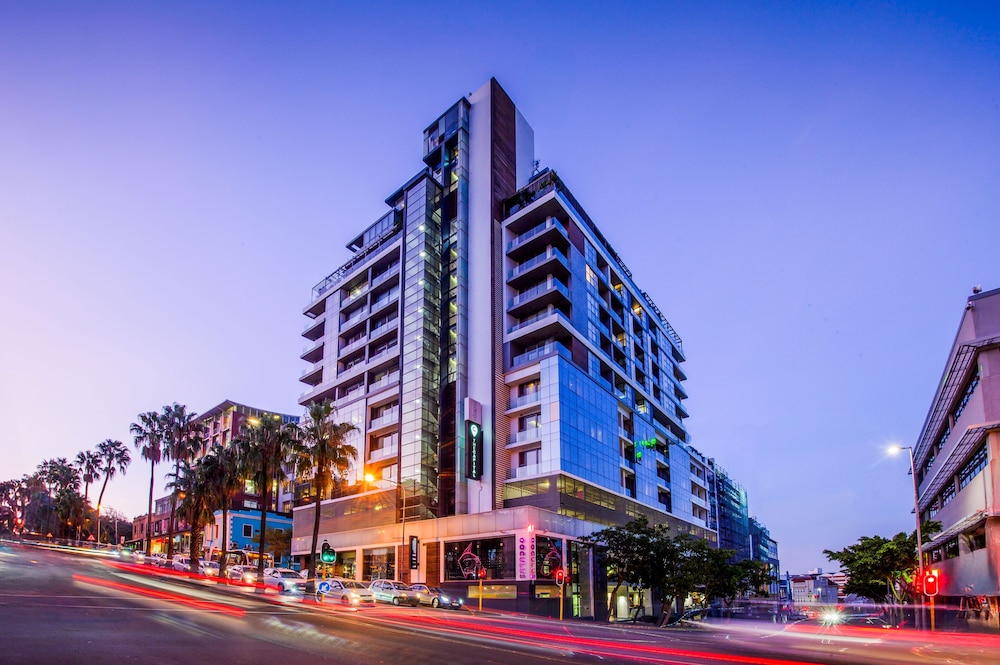
In the CBD proper — around Bree, Loop, Long and Buitengracht — the view is a matter of floor height. Above roughly the eighth floor you clear the neighbouring blocks and get Lion's Head, Signal Hill and a good angle on the front table; below it, you get a light well. Converted heritage buildings and apartment hotels here run R1,800-3,500 and typically compensate with a roof terrace where everyone gets the view at sunset. De Waterkant, on the slope above the CBD with its painted Cape Georgian cottages, does the same at a slightly higher price with a village feel and steep cobbled lanes.
The upper City Bowl — Gardens, Tamboerskloof, Oranjezicht — is where the geometry problem bites. Rooms there face the cliff face and the cable station, which is spectacular at night when the mountain is lit but is not the flat-table shape. What Gardens does have is the walk: Kloof Street's restaurants, the Company's Garden, the pink landmark Mount Nelson Hotel on Orange Street for a look at the grounds, and Platteklip Gorge trailhead a 20-minute uphill walk or a R70 Uber away.
Woodstock, Observatory and the eastern angle
From Woodstock and Observatory the mountain shows its Devil's Peak side — the sharp triangular buttress above the N2 with the old Rhodes Memorial pine slopes below. It is a less famous but more sculptural view, and it comes cheap: guesthouses and loft rooms in converted Woodstock warehouses off Albert Road run R900-1,800, with the Old Biscuit Mill and its Saturday market on your doorstep and the CBD five to ten minutes away by car. Observatory's Lower Main Road adds student bars, cheap Ethiopian and Indian food, and a 24-hour rhythm.
Be realistic about the surroundings. Both suburbs are gritty at street level, with light-industrial blocks, and both have a genuine petty-crime problem after dark — walk in company, use Uber or Bolt at night rather than strolling Albert Road, and keep your phone in a pocket. If you want the eastern angle in a calmer setting, look at Rondebosch and Newlands further south, where the mountain's wooded back slopes rise directly above the suburb and rooms go for R1,300-2,400.
What a view is actually worth per night
In practice a mountain-facing room costs R400-1,200 more than the same room facing a courtyard. The question is how much time you will spend in it. If you are out at 07:30 and back at 22:00, buy the cheap room and take the view from the hotel roof, the Sea Point promenade or the top of Signal Hill, where the noon gun fires at 12:00 on weekdays and the sunset parking fills by 18:30 in summer. If you plan slow mornings with coffee on a balcony, pay it — the light on the front face between 06:30 and 08:00 is the reason people fall for this city.
Also weigh cloud. From June to August the mountain is hidden behind rain cloud for days at a time, and the famous "tablecloth" of the south-easter blankets the summit through much of summer too. That is not a reason to avoid a view room, but it is a reason not to overpay in winter. Rooms with a mountain view in July go for close to courtyard prices in many hotels, which is the sensible month to splurge for very little extra.
How to book so you actually get the view
Listing sites are vague on purpose. Email the property and ask three questions: which compass direction the room faces, which floor it is on, and whether any building or tree obstructs the lower half of the window. Ask for a photograph taken from the room rather than the marketing shot. If the answer is evasive, book a flexible rate and request the specific room category on arrival — hotels in Cape Town are used to guests swapping for a view and will usually accommodate it for a small upgrade fee if occupancy allows.
Ranked by how reliably you get the classic image: Bloubergstrand first, the Waterfront and Mouille Point second, high-floor CBD third, Woodstock and Observatory fourth for the Devil's Peak angle, and the upper City Bowl last for shape but first for drama. If you can only do one thing to guarantee the view, go up Signal Hill or Lion's Head on your first clear evening — that costs nothing beyond fuel and settles whether the mountain-view room is worth another R700 a night to you.
Before you book
The questions people ask about City Bowl, answered with this month’s numbers.
Bloubergstrand, 20-25km north on the R27, gives the full flat-topped silhouette across Table Bay with Robben Island in front, at roughly R1,200-2,800 a night. The V&A Waterfront and Mouille Point are the best in-city alternatives if you want to stay walkable.
They have close-up cliff-face views rather than the postcard shape, because they sit directly beneath the front table. It is dramatic, especially when the mountain is floodlit at night, but if you want the classic table-and-Lion's-Head profile, book further north or across the bay.
Frequently. Winter storms from June to August can hide it for several days at a stretch, and the summer south-easter lays the "tablecloth" cloud over the summit on many afternoons. Cableway operations are weather-dependent, so check the operator's own status page on the morning you plan to go up.