Where to stay in Franschhoek: who the valley suits and what a night costs
 Oak-lined main street in Franschhoek with mountains rising behind the village
Franschhoek sits 75 km from Cape Town, packs its best restaurants into a 20-minute walk along one street, and charges roughly double City Bowl rates for the privilege.
The case for Franschhoek is narrow and it is strong
This is the only Winelands town where the restaurants people fly in for sit within a twenty-minute walk of each other. Huguenot Road runs from the Huguenot Memorial Monument at the top of the valley down to the traffic circle at the bottom, and almost everything worth your evening is on it or one block off: tasting rooms, galleries, the village square, the delis. If your idea of a wine trip is ordering the second bottle and then walking back to your room, book here. Stellenbosch is larger and cheaper, Paarl cheaper still, and neither compresses that much good eating into that small a radius.
It suits couples on two or three nights, groups of four to six taking a farm cottage, and anyone planning their days around the Franschhoek Wine Tram. It suits nobody travelling on a tight budget, and it is a poor base for a peninsula holiday. Franschhoek is about an hour from the city on the N1 and R45, which means a run to Boulders Beach or Camps Bay burns most of a day in the car. Families with young children often find the valley beautiful and boring by day two, because the entertainment here is entirely adult and entirely liquid.
What a night actually costs, and when that drops
Expect a decent guesthouse double at R1,600 to R2,800 in shoulder season, and R2,200 to R3,500 for the same room between mid-December and mid-January. Boutique properties with a pool, a garden and a proper breakfast sit at R3,500 to R6,500. The flagship suites on the estates run past R15,000 a night and are priced for people who are not reading a price paragraph. Self-catering cottages on the working farms out along the R45 are the value play for groups: R3,000 to R5,000 for something that sleeps six often beats two hotel rooms.
The honest comparison: a mid-range City Bowl room in Cape Town runs roughly R1,500 to R2,200, so Franschhoek carries a premium of anything from forty per cent to double for equivalent comfort. The premium collapses in winter. June, July and August bring cold nights, real rain and rates cut by thirty to forty per cent, with fires lit in the tasting rooms and restaurant tables available at a week's notice instead of a month's. If you can tolerate wet mountains, winter is when Franschhoek stops being expensive and starts being good value.
What is genuinely within walking distance
From a bed anywhere on or just off Huguenot Road between the monument and the village square, you can walk to twenty-odd restaurants, several in-town tasting rooms, a couple of good bakeries, the Huguenot Memorial Museum, a small supermarket and the pharmacy. The whole strip is about 1.5 km end to end and it is flat. Pavements are decent by South African village standards, and the evening walk between restaurants is one of the few in the Winelands that locals actually do rather than drive.
What is not walkable: the wine estates. Almost every farm you have heard of sits two to twelve kilometres out along the valley floor or up towards the Franschhoek Pass, and the roads have no shoulder. The Franschhoek Motor Museum and the estate restaurants on the Stellenbosch side are a drive. Mont Rochelle Nature Reserve is walkable from the village if you are prepared for a climb straight up out of town. Treat anything with the word estate in its name as a fifteen-minute round trip by car or tram, not a stroll.
Where the beds cluster, and which cluster to choose
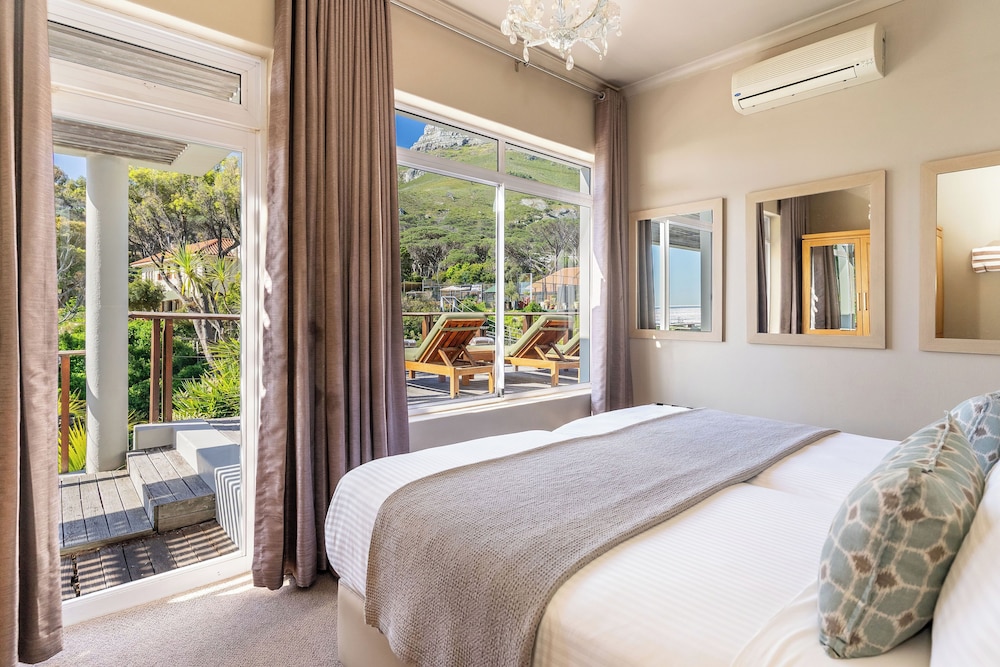
Three broad options. First, the village guesthouses on the side streets off Huguenot Road, mostly converted Victorian and Cape Dutch houses with six to twelve rooms, a pool and secure parking. This is the right choice for a first visit and for anyone who wants to drink at dinner. Second, the farm and estate accommodation strung along the R45 towards Simondium and out towards the Pass, quieter and more scenic, but committed to driving for every meal. Third, self-catering houses in the residential grid west of the main street, which are the cheapest way to sleep well here.
I would book the village every time on a two-night trip and the farms only on a four-night one, when you actually want a day of doing nothing by a pool with vines outside. Check two things before you commit: whether the property has off-street parking behind a gate, which almost all do and which matters, and how far it is from the bottom traffic circle, because the top of Huguenot Road near the monument is a fifteen-minute walk from the restaurant cluster, uphill on the way home.
Getting there and getting around without driving
There is no train to Franschhoek and no useful public bus. From Cape Town it is 75 to 80 km, an hour via the N1 and the R45 through Paarl, or a slower, prettier run via Stellenbosch and the Helshoogte Pass at about 90 minutes. Cape Town International is 60 km away, 45 to 55 minutes off-peak. Most people either self-drive or book a transfer, and a private car and driver for the day is common enough here that guesthouses will arrange one on request.
The Franschhoek Wine Tram is the reason you can visit without a designated driver. It runs colour-coded hop-on hop-off lines combining a vintage tram and open-sided tram-buses between the village and eight or so estates per line, and it is genuinely the sensible way to taste. Budget roughly R400 to R600 per person for a day ticket with tastings charged separately at around R80 to R150 a flight, and confirm the current fare and line schedule with the operator, because routes and pricing change. Book the tram before you book the restaurants.
Eating: what to reserve and what to skip
South Africa has no Michelin guide, so ignore any listing that claims stars here; the local benchmark is the Eat Out awards, and Franschhoek is consistently over-represented on them. The names to reserve well ahead are La Petite Colombe, Chefs Warehouse at Maison, Reuben's and Foliage, the last of which forages hard and prices gently by valley standards. Haute Cabrière is the reliable long lunch with a view. Out towards Simondium, Babel at Babylonstoren is a twenty-minute drive and worth the trip for the garden as much as the plate.
Skip the sit-down tasting menus at lunch if you also have a tasting menu booked for dinner, which sounds obvious and is the single most common mistake here. Skip the estates that charge for a tasting and then pour the same three wines you can buy in a Cape Town supermarket. And skip Saturday lunch in December unless you booked in October; the village fills with day-trippers from the city and the good tables go a month out. Two proper dinners and one long farm lunch is the correct three-day rhythm.
Timing the visit around the valley calendar
February and March are harvest, hot and dusty, with cellars working and afternoons well over 30C. April and May are the best all-round weeks: warm days, cold nights, autumn colour in the vines and shoulder pricing. July brings the Bastille weekend, a fancy-dress French festival that fills every bed in the valley and pushes rates to summer levels for three nights; the literary festival in May does something similar on a smaller scale. Check the exact dates with the organisers before you plan, because they move year to year.
The one thing to build a day around whatever the month is the Franschhoek Pass, the R45 climbing east out of the village towards Villiersdorp and Theewaterskloof Dam. It is fifteen minutes to the viewpoints, the road is properly surfaced, and it is the cheapest thing to do in a town where nothing else is. Combine it with an early walk up into Mont Rochelle Nature Reserve before the first tasting room opens at ten, and you have earned the rest of the day.
Before you book
The questions people ask about Franschhoek, answered with this month’s numbers.
Yes, for two or three nights. The village restaurants and shops are walkable, the Wine Tram handles the estates, and guesthouses arrange transfers from Cape Town or the airport. Beyond three nights it starts to chafe, because side trips to Stellenbosch, Paarl or the coast all need a vehicle or a costly private driver.
Day-trip it if you only want two tastings and a lunch, because an hour each way is manageable. Stay if you want to eat dinner properly, which is where the valley earns its reputation. One night is enough to justify the drive; two nights is the sweet spot for most couples.
June through August, when rates fall roughly thirty to forty per cent from summer levels. Expect cold, wet weather and short days, and check whether restaurants are running reduced winter hours before you build a menu-led trip around those dates. Avoid the July Bastille weekend, when prices jump back to peak.
Stellenbosch if you want a town with a university, museums, cheaper beds and something to do when it rains. Franschhoek if the trip is about eating and drinking within walking distance of your room. Stellenbosch also has far more accommodation stock, so it absorbs peak-season demand better than Franschhoek does.