Where to stay in Camps Bay: the sunset tax, explained
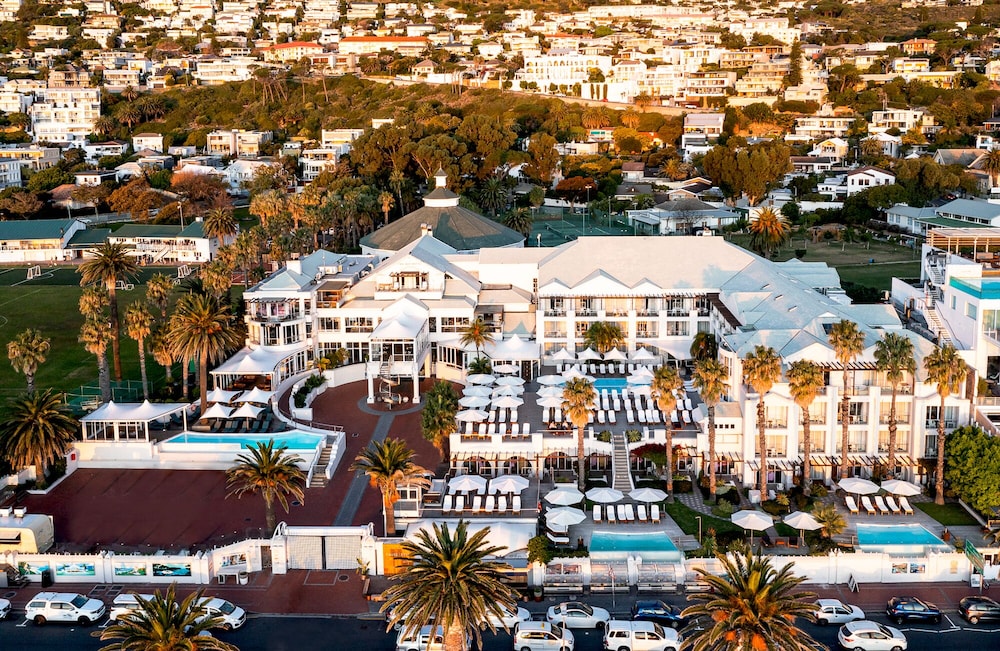
 Palm trees along Victoria Road at Camps Bay with the Twelve Apostles ridge rising behind the beach
Camps Bay charges roughly double Sea Point for the same square metre in December, and whether that is a bargain or a mistake comes down to three questions about your trip.
What you are actually paying for
Camps Bay is a single mile of white sand under the Twelve Apostles ridge, with a palm-lined strip of restaurants on Victoria Road facing it. The setting is genuinely world class, and there is no argument to be had about the view: the mountain wall goes gold at about seven in the evening in January and the whole suburb stops to look at it. Every rand of the premium is the view, the beach fifty metres from your gate, and the fact that a suburb this beautiful is fifteen minutes from a capital-city centre.
What you are not paying for is convenience. Camps Bay has one small shopping centre, a handful of grocery options, no hospital, no cinema and no real public transport spine beyond a bus corridor. Everything that is not sand, sunset or a cocktail is over the hill. Understand that before you book, because the commonest complaint from visitors here is not price but the discovery that a supermarket run, a hardware emergency or a late dinner outside the strip means a car and a 15 to 25 minute drive each way.
Who should book it
Couples on a short, deliberately indulgent trip in the shoulder months of March, April, October and November, when rates fall 40 to 50 percent under the December peak, the wind is manageable and the beach is not shoulder-to-shoulder. Groups of six to ten renting a villa on the slopes, where a R12,000 house divided eight ways lands near R1,500 a head with a pool, a braai and a view no hotel room delivers. Families with a hire car and small children, because the beach is soft, wide, patrolled in season and has a tidal pool at the southern end.
It also suits repeat visitors who have already done the museums, Robben Island and Bo-Kaap and now want a base for the coast road: Llandudno, Hout Bay, Chapman's Peak and Noordhoek all lie south, and Clifton is two minutes north. If your itinerary is beach, mountain and long lunches rather than city culture, Camps Bay puts you at the front of the queue every morning while people staying in Gardens are still parking.
Who should not
Anyone without a car. There are buses along the coast and over Kloof Nek, and e-hailing works, but a return trip to the CBD costs roughly R240 to R360 a day and surges on Friday and Saturday nights, when drivers are scarce leaving the strip after eleven. Over a week that is a hire car's worth of money spent on being stuck. Also anyone on a budget: the cheapest honest Camps Bay bed in high season is around R2,500, and there is essentially no hostel or backpacker stock.
Skip it too if you are wind-sensitive. The southeaster, the Cape Doctor, hammers this beach from roughly November to February, and on a bad day the sand blows hard enough to clear the beach by two in the afternoon while Clifton, tucked behind its granite boulders 2 km north, sits calm. And skip it in deep winter unless you specifically want moody: June to August brings northwesterly storms straight onto that exposed shore, several restaurants trim their hours, and the strip can feel abandoned on a wet Tuesday.
The price ladder, month by month
Shoulder season, roughly March to May and September to November, a comfortable two-person apartment or guesthouse room with a sea view sits at R2,200 to R4,000. Four- and five-star hotel rooms on Victoria Road and the slopes run R4,500 to R12,000. Villas with pools start around R6,000 for four bedrooms and climb past R30,000 for the trophy houses on the upper roads. Winter, June to August, knocks 30 to 50 percent off nearly everything, and it is the only time Camps Bay offers what an honest person would call value.
Then comes the December cliff. From roughly the fifteenth of December to the tenth of January, rates double or triple, most self-catering imposes a seven- or ten-night minimum, and the good stock is gone by August. If your dates are fixed in that window and your budget is not, book now and move on. If you have flexibility, shift to the first two weeks of December or the second half of January: the weather is nearly identical, the beach is emptier, and you will pay 40 percent less for the same balcony.
The sub-strips: which street to aim for
Victoria Road beachfront is the loud, convenient front line: restaurants, bars, foot traffic, and music from the beach clubs until late in summer. Great for a two-night blowout, poor for sleep. One block up, the streets climbing off The Drive and Camps Bay Drive give you the same view with 80 percent less noise and a two-minute walk down; this is where I would book. Higher again, around Geneva Drive and the roads towards Kloof Nek, you get bigger houses, better views, cooler nights and a walk back up that is not trivial.
Bakoven, the small rocky cove about 1.5 km south, is the quiet alternative: cottages and apartments tucked among boulders, no restaurant strip, and a genuinely local feel, usually R300 to R800 a night cheaper than equivalent Camps Bay stock. Glen Beach, at the northern end, is the surfers' corner, and the flats above it are close to both Camps Bay and Clifton. Avoid the units directly above the busiest bars unless late music is the point, and always ask specifically about off-street parking, which is the suburb's scarcest resource.
The walking radius
From the middle of Victoria Road you can reach the beach in under a minute, roughly twenty restaurants and bars in five, the small shopping centre with a supermarket in seven, and the Camps Bay tidal pool at the southern end in ten. Theatre on the Bay, the suburb's playhouse on Link Street, is a five-minute walk and worth checking for a show. Maiden's Cove, the picnic and tidal pool site between Camps Bay and Clifton, is about 20 minutes on foot along the coast path, and Clifton Fourth Beach roughly 30.
That is the entire walkable inventory, and it is why Camps Bay divides opinion. There is no bookshop, no museum, no market and no second neighbourhood next door to explore on foot. Beyond that radius you are driving or paying: Sea Point 12 to 20 minutes, the CBD 15 to 25, the Waterfront 20 to 30, Hout Bay 20, Kirstenbosch 25 to 35, the airport 30 to 50. All of those swell substantially on summer afternoons when Victoria Road becomes a single slow line of cars looking for parking.
Practical rules for booking well here
Insist on knowing which way the property faces. West-facing means sunsets and full afternoon sun on the balcony, which in February is 32 degrees of it; ask whether there is shade. Ask whether parking is allocated or on-street, because on-street in December means circling. Ask about the walk from the parking to the door, since many slope properties involve forty steps. If you are booking a villa, confirm whether the pool is heated, because Atlantic-side evenings in October are cooler than the brochure photograph suggests.
One more thing worth planning: sunset dinner reservations on the strip should be made days ahead in season, not on the day. And treat the beach with respect. The water sits at roughly 12 to 16 degrees, the shore break is punchy, and swimming should be done between the flags when lifeguards are on duty. Blue Flag status is reviewed season by season, so check the current listing rather than assuming. If you want warm water, drive 45 minutes to Muizenberg on the False Bay side, where the sea runs several degrees warmer.
Before you book
The questions people ask about Camps Bay, answered with this month’s numbers.
Effectively yes, unless you plan to stay on the strip for most of your trip. Without one, expect roughly R240 to R360 a day in e-hailing for city trips, with surge pricing late on weekend nights. A small hire car costs less than that over a week and solves the supermarket problem.
Some days, yes. The southeaster blows hardest from November to February and can clear the beach by mid-afternoon. Clifton, two minutes north, is sheltered by granite boulders and is the standard local fallback. Check the wind forecast the night before and plan the beach for the morning.
Camps Bay if you want restaurants, shops and a lifeguarded family beach on your doorstep. Clifton if you want calmer air and quieter sand and are content to drive or walk for every meal. Clifton is also more expensive per night and has far less accommodation stock.
June to August, when rates fall 30 to 50 percent below shoulder season and well under half the December peak. You will get storms and short days, but also empty restaurants, dramatic seas and hotel rooms with sea views for what a City Bowl guesthouse charges in January.