Cape Dutch manor houses and heritage hotels around Cape Town
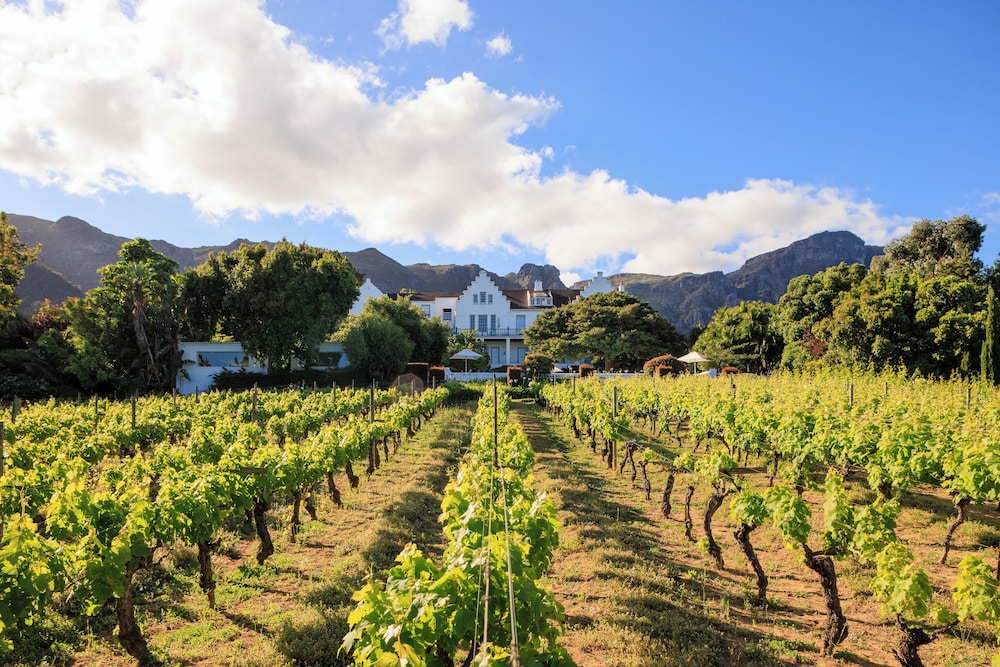
 Whitewashed Cape Dutch gable and thatched roof of a historic manor house hotel near Stellenbosch
Ten kinds of historic stay across the peninsula and the Winelands, from 300-year-old werf farmsteads at R6,000 a night to R1,400 Victorian rooms in the City Bowl, with the trade-offs old buildings never advertise.
What counts as heritage here
Four distinct architectural layers, and knowing them helps you book the right one. Cape Dutch, roughly 1700 to 1820, means whitewashed walls, thatch, small-paned sash windows and the curved central gable, usually arranged as a werf of manor house, slave quarters, cellar and outbuildings around a courtyard. Georgian and Regency townhouses came next, flat-roofed with parapets, and you see them in the Bo-Kaap and lower City Bowl. Victorian and Edwardian villas with cast-iron broekie-lace verandas fill Gardens, Observatory, Woodstock and the southern suburbs. Then 1930s Art Deco along St George's Mall and lower Long Street, still underused as hotel stock.
This history is not decorative. These buildings were the infrastructure of a colonial farming economy built on enslaved labour, and the better estate hotels now say so explicitly, with interpretation of the slave quarters and burial grounds on the werf rather than a soft-focus story about gracious living. If that context matters to you, ask what the property tells guests, because the range is wide. The Iziko Slave Lodge on Adderley Street, a 1679 building that housed enslaved people owned by the Dutch East India Company, is the right first stop before any Winelands stay.
1 and 2: the Constantia werf estates
Constantia is the oldest wine-farming valley in the country, planted from the 1680s, and its estate hotels are first on this list because you get a genuine 18th-century werf 25 minutes from the city. Manor rooms and converted outbuildings run R4,000 to R9,000 a night, set among oaks and vines with the Constantiaberg above. Groot Constantia, the historic core of the original grant, is open to visitors as a museum and wine estate even where it does not offer rooms, so a heritage stay in the valley comes with the real thing on your doorstep. You need a car.
Second, and cheaper, are the Constantia garden cottages and small guesthouses on Spaanschemat River Road and the lanes off it, R2,000 to R4,000. These are usually 19th and early 20th-century outbuildings rather than manor houses, but they sit on the same land, share the same oaks and put you on the Alphen Trail before breakfast. Book these if the setting matters more than the gable. The valley's honest catch, for both tiers, is isolation: no walkable dinner, no shop after 18:00, and a dark drive back from anywhere. Budget R400 a day in ride-hailing if you are not driving.
3 and 4: Stellenbosch manor hotels and Dorp Street
Third are the manor-house hotels on the estates ringing Stellenbosch, some in buildings dating to the 1690s, with rooms from R3,500 to R8,000 and cellars, gardens and mountain backdrops. The town was founded in 1679 and the density of intact Cape Dutch and Victorian building around it is the highest in the country. Trade-offs are consistent across the tier: thick walls that stay cold in July, no lifts to first-floor rooms, and heritage rules that mean air conditioning is often absent in the oldest wings. Summer afternoons over 32C are common in January, so ask about ceiling fans.
Fourth, and better value, are the guesthouses along Dorp Street and the oak-lined blocks around it, R1,600 to R3,200. Dorp Street is one of the longest continuous rows of historic buildings in South Africa, and staying on it means walking to restaurants, the university museums and a dozen tasting rooms without touching a car. Rooms are smaller and bathrooms are squeezed into former dressing rooms, which is the price of a listed facade. This is where I would put a couple doing three nights of Winelands with no interest in a farm's evening isolation.
5 and 6: Franschhoek and Paarl
Franschhoek, settled by Huguenots from 1688, is fifth: a single main street of restored Cape Dutch and Victorian frontages, gabled estate hotels in the valley at R4,000 to R12,000, and village guesthouses at R2,200 to R4,500. It is the most polished heritage destination in the Cape and also the most expensive and the most curated. The wine tram makes it car-free for a day, which is genuinely useful. The catch is that Huguenot Road can feel like a stage set in high season, and December rates are punishing. Come in May for the same buildings at 40 percent less.
Paarl, sixth, is the working alternative 20 minutes north: a very long Main Street lined with Cape Dutch, Georgian and Victorian buildings, guesthouses at R1,300 to R2,800, and manor-house hotels on the estates from R3,000. It has none of Franschhoek's gloss and considerably better value, plus the granite domes of Paarl Mountain and the Afrikaans language monument above the town. Restaurants close earlier and the town centre is quiet at night. Book Paarl if you want a Winelands heritage base for four nights and would rather spend the difference on tastings than on the room.
7 and 8: the City Bowl's Victorian and Edwardian stock
Seventh are the converted Victorian villas of Gardens, Oranjezicht and Tamboerskloof, on the streets climbing from Kloof Street towards the mountain: pressed ceilings, teak floors, verandas with cast-iron detail, and rooms at R1,800 to R4,000. You are ten minutes' walk from Kloof Street's restaurants and twenty from Bree Street, with Table Mountain filling the window. Trade-offs are steep streets, no lifts, and winter cold, since these houses were built for summer and few have insulation. The oldest and grandest hotel in the city, opened on Orange Street in 1899 and pink since the years after the First World War, anchors this district.
Eighth are the balconied buildings on Long Street, where the Victorian iron verandas run for several blocks and the upper floors have become guesthouses and small hotels at R1,200 to R2,600. Nothing else in Cape Town looks like it, and it is the cheapest way to sleep inside a heritage facade. Be clear-eyed about the noise: Long Street is the city's late-night strip and rooms on the street side are loud until 03:00 on Friday and Saturday. Take a back room, or take Loop Street one block over, which has the same architecture and a fraction of the volume.
9 and 10: Simon's Town, Kalk Bay and the Bo-Kaap
Ninth is Simon's Town, a Royal Navy base from 1814 and a South African one since 1957, where St George's Street is a near-continuous run of Georgian and Victorian buildings and the guesthouses above the harbour run R1,400 to R3,200. You get penguins at Boulders, the naval museum, and a 45-minute drive to the city. Kalk Bay next door adds fishermen's cottages at similar rates with better restaurants. Both are working towns rather than preserved ones, which is exactly why they feel real, and both are cold and wet in a July south-westerly.
Tenth, and the most culturally significant, are the Bo-Kaap guesthouses in the flat-roofed 18th and 19th-century row houses on Wale, Chiappini and Rose Streets, R1,200 to R2,600. This is a living Cape Malay neighbourhood whose residents have been fighting displacement for years, so choose owner-run houses over investor conversions, and treat the streets as somebody's home rather than a photo backdrop. Rooms are small and parking is very difficult. The reward is walking into the city centre in ten minutes from the most distinctive streetscape in South Africa.
The trade-offs nobody lists, and my pick
Old buildings come with a consistent set of catches. Thatch means strict fire rules, no smoking anywhere near the roofline and, in some estates, no in-room air conditioning. Thick walls hold the cold, so a July night in an unheated manor room is genuinely chilly and you should ask what heating exists rather than assume. Listed status prevents lifts, so a first-floor room means a staircase with a suitcase. Plumbing retrofitted into 200-year-old walls is noisy. Summer mosquitoes near the Winelands rivers are real from December to March. And rural estates lose power in storms like everyone else.
If I had three nights and wanted the architecture without the isolation, I would take Dorp Street in Stellenbosch and walk everywhere. If I had a car and a bigger budget, a Constantia werf estate is the best combination of genuine age and proximity to the city, and you can be at Kirstenbosch in twelve minutes. Skip a modern building with a bolted-on gable, which the Winelands has plenty of, and always ask when the structure was actually built rather than accepting the word historic on a booking page.
Before you book
The questions people ask about Constantia, answered with this month’s numbers.
The good ones have modern bathrooms and beds inside historic shells, but expect no lift, occasional cold in July, and air conditioning missing from the oldest thatched wings for fire-regulation reasons. Ask about heating, cooling and stairs before booking a first-floor manor room, especially if anyone in your party has mobility limits.
Stellenbosch's Dorp Street area or the City Bowl. Both put historic buildings, restaurants and museums within a ten-minute walk. Constantia, Franschhoek's estates and Paarl all require driving or ride-hailing, with typical evening fares of R150 to R400 each way and limited availability late at night in the Winelands.
Ask what the property tells guests about the enslaved people who built and worked the werf; the better estates now interpret the outbuildings and burial grounds honestly. Visit the Iziko Slave Lodge on Adderley Street, in a 1679 Dutch East India Company building, before or after your Winelands stay for essential context.