Constantia area guide: sleeping in a wine valley inside the city
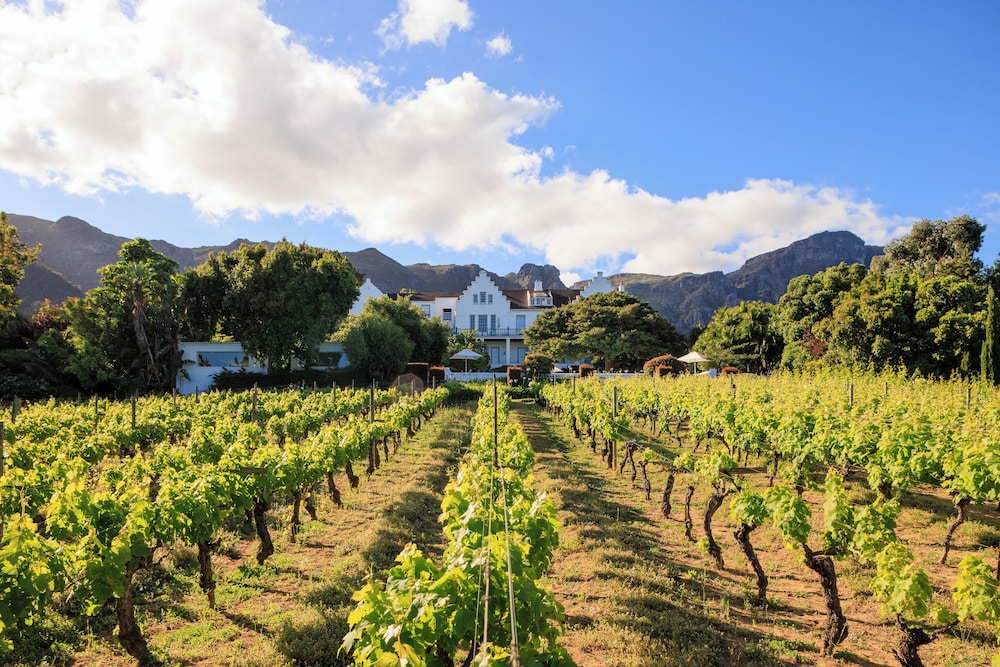
 Oak-lined lane running between vineyards on a Constantia wine estate below the Constantiaberg
Constantia has eight working wine estates, one shopping centre and no pavement culture at all, and it sits about 15 km from the CBD with a hire car as the price of admission.
What Constantia is
Constantia is the green eastern flank of the Table Mountain chain, a valley of oaks, horse paddocks and vineyards running from Constantia Nek down towards Tokai. It is the oldest wine-producing area in South Africa: Groot Constantia dates to 1685, and Klein Constantia's sweet Vin de Constance revived a wine that was drunk in eighteenth-century European courts. Estates including Buitenverwachting, Steenberg, Beau Constantia, Eagles' Nest and Constantia Glen sit within a few kilometres of each other, most with restaurants, all with tastings, and several open year-round.
It is also a low-density, high-value residential suburb with almost no street life. There is one significant retail node at Constantia Village on Spaanschemat River Road, a scattering of restaurants attached to estates, and otherwise walls, hedges and long driveways. The distinction matters: this is a wine district you sleep in, not a village you wander. Booking here without understanding that produces the same disappointed review every time, from someone who expected to stroll to a bakery and found a 2 km walk on a road with no pavement.
Who should book Constantia
Wine-focused travellers who want tasting rooms within a ten-minute drive of bed, which removes the whole designated-driver problem that dogs a Stellenbosch day trip from town. Families and multi-generation groups, because the stock here is houses and garden guesthouses with pools, lawns and space, at prices that undercut the Atlantic seaboard for square metres. Golfers, with Steenberg and Westlake close by. And repeat visitors who have done the city and want a slower, greener week with Kirstenbosch, the Silvermine trails and Tokai forest on the doorstep.
It suits winter travellers unusually well. June to August is Cape Town's rainy season, and a Constantia guesthouse with a fireplace, a long lunch at an estate restaurant and a wet oak avenue outside is a far better wet-weather proposition than a windswept apartment in Sea Point. Rates fall 30 to 40 percent, the tasting rooms are quiet enough for real conversation with the pourer, and the valley is at its greenest. This is the one Cape Town area I would actively recommend booking in July.
Who should not
Anyone without a car, absolutely and without exception. There is no walkable centre, the bus network is thin here, and e-hailing to the CBD costs roughly R200 to R320 each way with longer waits than in town. Young travellers looking for nightlife: the valley is asleep by ten and the nearest late bars are in Claremont or the City Bowl. Beach holidaymakers, since the nearest swimmable sand is Muizenberg, 20 to 25 minutes over the hill, or Hout Bay, 15 minutes west over Constantia Nek.
Short-trip first-timers should also think twice. If you have four nights and want Table Mountain, Robben Island, Bo-Kaap and the Waterfront, staying 15 km out with a 30 to 50 minute morning commute on the M3 is a poor use of them. Constantia earns its place on trips of seven nights or more, or on trips where wine and mountain walking are the point. On a short city break it is a beautiful place to spend one afternoon and the wrong place to sleep.
Prices and what the money buys
Garden guesthouses and B&Bs in the valley run roughly R1,400 to R3,000 a night in shoulder season for a double with breakfast, which is comparable to Sea Point but buys a bigger room, a garden and usually parking. Boutique country-house hotels on and around the estates sit at R3,500 to R12,000. Self-catering cottages on smallholdings are the value pick at R1,200 to R2,600. Whole houses with pools, four bedrooms and mountain views run R5,000 to R15,000, which for a group of eight lands well under R2,000 a head.
The festive peak from mid-December to mid-January adds 40 to 80 percent, less aggressively than the Atlantic seaboard, and there is more availability late because domestic holidaymakers chase the sea. Winter takes 30 to 40 percent off. Compared with the rest of the city: you will pay roughly what Sea Point costs, half what Camps Bay costs in December, and considerably less than the Waterfront, while getting the largest private space of any Cape Town area at that price point. The car hire, roughly R400 to R900 a day, is the offsetting cost.
The pockets of the valley
Upper Constantia, on the slopes below the Constantiaberg, has the biggest views and the steepest driveways, with Constantia Nek at the top for the trail up to the Table Mountain back table and the road over to Hout Bay. Bel Ombre and the Alphen area, around Alphen Drive and the old Cape Dutch manor complex, are the most central for restaurants and the Constantia Village shops. Spaanschemat River Road runs the length of the valley floor past nurseries, farm stalls and the Constantia Uitsig and Buitenverwachting turnoffs.
The Tokai and Steenberg end, further south, is flatter, slightly cheaper, and closest to the Tokai forest trails and the Steenberg estate with its golf course and restaurant. The Bishopscourt border to the north is the most expensive residential ground and puts you within five minutes of Kirstenbosch. If I were booking one address for a first Constantia stay, it would be within walking distance of Constantia Village, because being able to reach a supermarket and a pharmacy on foot changes the character of a week here considerably.
Eating and tasting without driving far
The valley's restaurant strength is estate dining rather than a high street. Bistro Sixteen82 at Steenberg does long lunches with vineyard views; Open Door at Constantia Uitsig and Foxcroft at High Constantia are serious kitchens; La Colombe, up at Silvermist near Constantia Nek, is one of the most decorated restaurants in the country and books out weeks ahead. Peddlars on the Bend on Spaanschemat River Road is the local pub-with-a-garden. Groot Constantia has both a tasting cellar and restaurants and is the obvious first stop for the history.
Book ahead for anything at the top end, particularly Thursday to Sunday and throughout December. For tastings, aim for weekday mornings when the rooms are quiet and the staff have time. Most estates charge in the region of R80 to R250 for a flight depending on the wines, often waived against a purchase; confirm with the estate, since fees change season to season. Arrange a driver if you are tasting seriously; the valley roads are dark, winding and heavily policed for drink-driving, and the penalties in South Africa are severe.
Driving, traffic and timing your days
The M3 is the artery: Constantia to the CBD is about 15 km and 20 to 25 minutes off-peak, and 40 to 55 minutes between seven and nine on a weekday morning when the southern suburbs commute and the school run collide. Going the other way in the evening peak is equally slow. Plan city days to leave after nine thirty and return after seven, and the drive stays civilised. The airport is roughly 25 km and 25 to 40 minutes via the M3 and N2, which is often quicker than from the Atlantic seaboard.
Other run times from the valley: Kirstenbosch 5 to 10 minutes, Muizenberg and the False Bay beaches 20 to 25, Simon's Town and the penguins 35 to 45, Cape Point about an hour, Stellenbosch 35 to 45 on the M3 and N2, Hout Bay 15 over the nek. That spread is Constantia's real argument: no other Cape Town base sits within 45 minutes of the winelands, the warm-water beaches, the botanic garden and the city at once. Whether that outweighs a daily drive is the only question you need to answer.
Before you book
The questions people ask about Constantia, answered with this month’s numbers.
Yes. There is no walkable centre beyond Constantia Village, public transport is limited, and e-hailing to the city runs roughly R200 to R320 each way. Budget R400 to R900 a day for a hire car and treat it as part of the accommodation cost when comparing with Sea Point or the City Bowl.
For a first Cape Town trip, yes, because you keep the city, Kirstenbosch and the beaches within 45 minutes while sleeping among vineyards. Stellenbosch has far more estates and a proper university town to walk around, so it wins for a dedicated wine week of four nights or more.
Bad between roughly seven and nine on weekday mornings and four to six in the evening, when a 20-minute run to the CBD stretches to 40 to 55 minutes. Outside those windows it is a fast, scenic road along the mountain. Shift your city days accordingly and the problem largely disappears.
It is the best Cape Town area for a wet-season stay. Rates drop 30 to 40 percent, the valley is green, estate restaurants have fires going, and tasting rooms are quiet. Pack for rain and cold nights of around 8 degrees, and confirm your property has proper heating.